.png)
I Practiced Visio Divina Before I Knew Its Name
Updated: Sep 19
By: Corinne
Visio divina, or 'divine seeing,' is a way of praying with images. My first experience of visio divina happened long before I knew such a practice existed.
It was years ago. The courts had just sent our foster daughter back to her biological family, and our last hope of parenthood had left with her. A week later, on a Wednesday evening, I dragged myself to our small midweek service, mostly because staying home felt worse.
The banner above the choir immediately drew my attention. It was green and depicted a boat battered by waves in a storm. My mind reached for something I'd recently watched and which had clearly left an impression on me: a UNICEF film called Unfairy Tales, about a seven-year-old refugee crossing the Mediterranean in a small boat. The banner and the memory fused, and before I could stop it, I saw myself in that boat. The waves were mine.
Then a second thought arrived out of nowhere: this banner of a storm is hanging inside the sanctuary. Whatever storm it depicted, the banner itself was protected. The walls were keeping out the rain. Then it hit me. Yes, I was weathering a storm, but I was weathering it inside the church, held by my church family the way those walls held that banner. The waves didn't stop. The storm was still blowing, but I knew I was held.
Nobody taught me to do that. That night, that banner carried a message just for me. All I did was look at it long enough for my life to meet it. Only later did I learn the ancient name for it: visio divina. Praying with an image the way lectio divina prays with a text.
I tell that story because visio divina has a reputation for being esoteric. It isn't. If an image has ever stopped you in your tracks, you already know what I'm talking about. Since July, our contemplation group has been learning the practice together. Each week starts with ten minutes of centering prayer, grounding ourselves in God's presence; then we turn to an image and move through four unhurried movements — gaze, ponder, respond, rest.
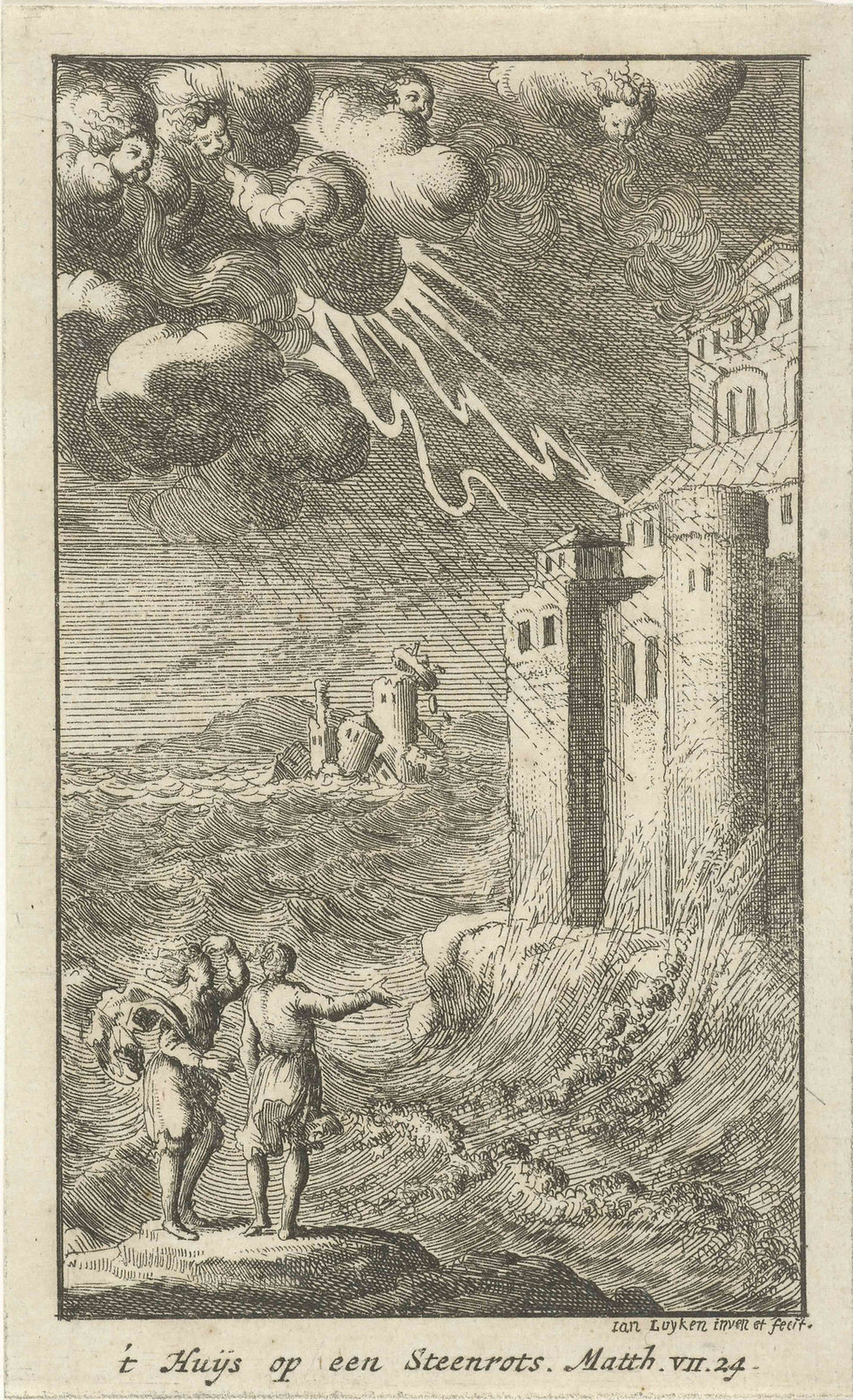
Last week we sat with a 350-year-old etching by Jan Luyken: two houses caught in a storm. One house standing solid on its rock while waves shatter against it; the other toppling into the flood. Both weathering the same storm.
As people shared what had caught their attention and where in the scene they had found themselves, something dawned on me: this etching explains contemplation. Because the standing house does nothing during the storm. All the decisive work happened long before, out of sight, in the foundation. The difference was never the storm; it was what each house was resting on.
That's what our group is doing on Monday evenings. We sit in silence and dig a little further down toward rock. Nobody watching would call it dramatic. That's because contemplation never looks like much from the outside. It is foundation work--for the storms that are yet to come.
I'd been struggling for weeks to explain contemplation. If you had told me the explanation would arrive in an old etching of two buildings in a storm, I would have laughed. But that's what visio divina does. God has been leaving his word lying around in pictures all along. We just have to look slowly enough to read it.
Practice Visio Divina with our Contemplation Lab

Here's a related practice you might want to give a try: Ignatian Contemplation, or praying with your imagination.

Вітаю всіх присутніх! Я слухав місцевий спортивний подкаст, де цю платформу згадали як спонсора випуску. Зайшов перевірити гнучкість лімітів на депозит та виведення коштів, оскільки не люблю робити ставки на великі суми. Особливість, яка мені сподобалася, — це можливість почати з дуже малих сум, що підходить багатьом в Україні. Я задоволений своїм досвідом з https://casinos.mriya.social/casino/unlim-casino/, оскільки це не створює фінансового тиску на гравців і залишає можливість кожному брати участь відповідно до свого бюджету. Досвід був спокійним і вільним від будь-якого тиску чи великих фінансових зобов'язань.